

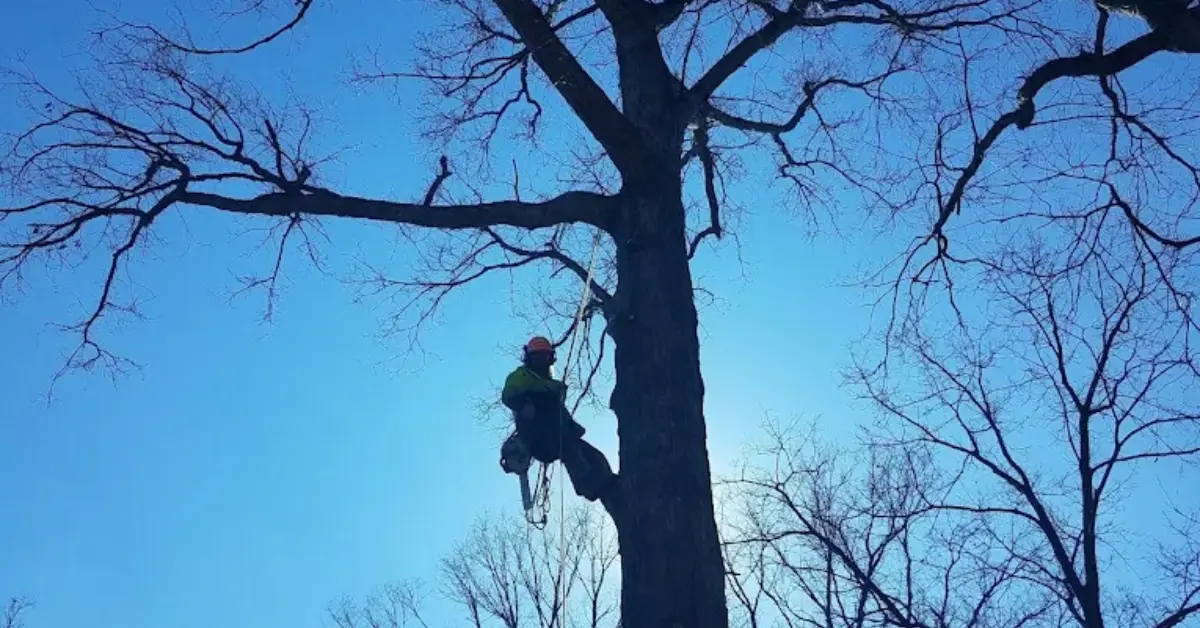
A tree can look completely healthy from the street while serious decay develops inside the trunk or root system. Most tree failures in Southwest Indiana do not announce themselves. They happen during the next derecho, the next ice storm, or the next saturated clay soil event after years of undetected internal decline.
GE Tree Service provides professional arborist evaluations and certified tree risk assessments across Petersburg, IN, and Southwest Indiana. We identify hidden structural defects, active decay, and pest damage before they become a liability on your property.
📞 CALL NOW: (812) 354-6119
When Petersburg Area Homeowners Need an Arborist Evaluation
Early detection is the only way to save a stressed tree or prevent an unexpected failure. Do not wait for visible collapse. Schedule a professional tree health assessment if you notice any of these conditions.
- Basal decay or fungi: Mushrooms or shelf fungi growing at the root flare indicate active root rot or heartwood decay that cannot be reversed without intervention
- Thinning canopy or dieback: A tree losing leaves or branches from the top down may be suffering from nutrient deficiency, root stress, or Emerald Ash Borer infestation
- Structural anomalies: Deep vertical cracks, including bark where two co-dominant stems push against each other, or a sudden lean, are signs of imminent structural failure
- Leaf discoloration: Yellowing or spotted leaves signal soil pH issues or fungal leaf spot common in the humid summers throughout the Wabash Valley
- Post-storm stress: High winds during a derecho can cause invisible root heaving and internal trunk fractures that require expert inspection even when the tree is still standing
- Trees near structures: Any mature hardwood within striking distance of your home, garage, vehicle, or outbuilding in Daviess or Pike Counties warrants a formal risk assessment
- Pre-sale or insurance requirements: Lenders, insurers, and HOAs across Southwest Indiana increasingly require written arborist reports for property transactions and claims
What Our Arborist Evaluation Covers in Southwest Indiana
Every evaluation follows a structured, science-based protocol. We do not guess. We assess.
Level 1 and 2 Visual Assessment: A full 360-degree inspection of the root flare, trunk, and canopy. We identify external indicators of internal decay, evaluate overall tree architecture, and assess structural defect patterns specific to each species.
Diagnostic Probing and Sounding: Specialized tools check for hollow spots and wood density loss. For high-value or high-risk trees, we deploy our aerial lift for detailed upper-canopy inspection of branch attachments, cracks, and inclusions that are invisible from the ground.
Site and Soil Analysis: We evaluate soil compaction, drainage patterns, proximity to structures, and environmental stressors specific to the clay-heavy soils and seasonal flooding common throughout the Petersburg and Washington areas.
Written Mitigation Report: A clear technical summary of findings with specific recommendations. This may include pruning, cabling and bracing, systemic injections, soil amendments, or hazardous tree removal where the risk level does not support retention.
Local Conditions That Make Arborist Evaluations Essential in Southwest Indiana
The Wabash Valley is harder on trees than most homeowners realize. Environmental stressors here accelerate structural decline faster than in many other regions.
- Clay-heavy soils throughout Daviess and Pike Counties limit drainage, promote root rot, and reduce a tree’s ability to anchor itself under wind load. A tree that looks stable above ground may have a significant root system compromise below grade.
- Derecho events have caused repeated widespread canopy failure across Daviess, Gibson, and Knox Counties. Trees with undetected co-dominant stems, including bark or internal decay, fail at disproportionately higher rates during these events.
- Emerald Ash Borer has killed the vast majority of ash trees across Southwest Indiana. Early-stage infestations are detectable through exit holes and upper canopy thinning before full mortality occurs. Preventative treatment is only viable during early detection.
- Seasonal flooding in low-lying areas near the Patoka River corridor and creek bottomlands saturates root zones repeatedly, accelerating fungal root rot in Silver Maple, Sycamore, and River Birch species common throughout the region.
- High humidity summers in Southwest Indiana create persistent fungal pressure. Oak leaf blister, tar spot on Maples, and anthracnose on Sycamore all weaken canopy structure over multiple seasons if left undiagnosed and untreated.
Did You Know? Arborist Evaluation Facts for Daviess County Homeowners
- Internal trunk decay can consume 60 percent of a tree’s structural wood before any external symptoms appear on the bark or canopy.
- Trees within striking distance of a structure are statistically involved in the majority of storm-related property damage claims across Southwest Indiana.
- A professional arborist evaluation typically costs a fraction of the emergency removal and property repair bill that follows an undetected failure.
- Emerald Ash Borer preventative treatment is only viable during the early infestation window. Once canopy decline exceeds 50 percent, treatment is no longer effective, and removal becomes the only option.
- Insurance adjusters and real estate attorneys across Indiana increasingly require written ISA-standard arborist reports for property claims and transactions involving mature trees
- Cabling and bracing can extend the safe life of a structurally compromised tree by years when the defect is caught early enough to make retention viable
Our Evaluation Process for Petersburg and Surrounding Areas
- Step 1 – Initial Consultation: We discuss your concerns, the tree’s history, and any recent storm events or symptoms you have observed on the property
- Step 2 – Ground-Level Assessment: Full 360-degree inspection of root flare, trunk, bark, and lower canopy for external decay indicators, structural defects, and pest damage
- Step 3 – Upper Canopy Inspection: Aerial lift deployed for high-value or high-risk specimens requiring detailed inspection of upper branch attachments, cracks, and co-dominant stem conditions
- Step 4 – Soil and Site Analysis: Drainage patterns, soil compaction, proximity to structures, and environmental stressors are assessed and documented
- Step 5 – Written Report and Recommendations: Clear technical summary with specific mitigation steps, risk rating, and priority timeline for any recommended work
📞 CALL NOW: (812) 354-6119
What Affects Arborist Evaluation Cost in the Petersburg Area
Evaluation cost depends on the number of trees, the level of inspection required, and equipment needs.
- Number of trees: A single specimen assessment is a different scope than a multi-tree woodlot or pre-construction survey
- Level of detail: A standard visual risk assessment costs less than a full diagnostic for a rare or severely compromised specimen requiring laboratory soil or pathogen testing
- Equipment use: Aerial lift deployment for upper canopy inspection is reflected in the estimate
- Report requirements: Insurance documentation, HOA submissions, or pre-sale reports requiring formal written certification carry an additional scope
Free consultation on every evaluation. We provide clear pricing before any assessment begins.
📞 CALL NOW: (812) 354-6119
Why Southwest Indiana Property Owners Trust GE Tree Service for Tree Risk Assessments
- 33 years of monitoring tree health across Daviess, Dubois, Gibson, Knox, and Pike Counties
- ISA Members and TCIA Members meet the highest industry assessment standards
- Aerial lift access for upper canopy inspections that ground-based evaluations cannot reach
- Certified pest and disease diagnosis, including Emerald Ash Borer, oak wilt, and fungal root rot
- Indiana Commercial Pesticide License 255155 and Applicator License 275795 covering treatment recommendations
- Systemic injection capability for preventative and treatment applications following evaluation
- Written reports accepted by insurance companies, HOAs, and real estate professionals across Southwest Indiana
- BBB Accredited A+ Rated, family-owned and locally operated since 1991
Arborist Evaluation Service Area in Southwest Indiana
GE Tree Service provides certified arborist evaluations throughout Southwest Indiana from our base at 1202 Spruce St, Petersburg, IN 47567.
- Pike County: Petersburg, Otwell, Winslow, Velpen
- Daviess County: Washington, Montgomery, Cannelburg, Plainville, Spurgeon, Stendal, Monroe City
- Dubois County: Jasper, Huntingburg, Ireland
- Gibson County: Princeton, Fort Branch, Oakland City
- Knox County: Vincennes, Monroe City
Frequently Asked Questions About Arborist Evaluations in Petersburg, IN
Is an arborist evaluation the same as a free estimate?
No. A free estimate is a quote for a specific service, like removal or pruning. An arborist evaluation is a professional diagnostic service where we analyze tree health, structural integrity, and risk level and provide a written technical report with specific recommendations.
How long does an arborist evaluation take in Southwest Indiana?
Most evaluations take 30 minutes to 2 hours, depending on the number of trees, species, and level of inspection required. Upper canopy assessments requiring aerial lift deployment take longer than standard ground-level assessments.
Can an arborist save a dying tree in Daviess County?
Often yes. Nutrient deficiencies, early-stage pest infestations, and fungal issues caught before significant decline can be treated with systemic injections, targeted pruning, and soil amendments. An on-site evaluation determines whether treatment is viable or removal is the safer option.
Will you provide a written report for insurance or an HOA in Southwest Indiana?
Yes. We provide technical written reports detailing health status and risk level accepted by insurance adjusters, HOAs, and real estate professionals across Daviess, Gibson, and Knox Counties.
How often should mature trees be professionally evaluated?
Every 3 to 5 years for healthy mature hardwoods. Immediately following any severe storm event across Southwest Indiana. Any time you notice sudden canopy changes, new lean, or fungal growth at the base.
Do you evaluate trees on construction sites in Daviess County?
Yes. Pre-construction evaluations identify which trees are healthy enough to save and establish root zone protection protocols before excavation begins on new builds throughout the Petersburg and Washington areas.
What is cabling and bracing, and when do you recommend it?
Cabling and bracing installs support cables between co-dominant stems or weak branch attachments to reduce failure risk. We only recommend it after a formal evaluation confirms the defect is manageable and the tree’s overall condition supports long-term retention.
Take the Guesswork Out of Tree Safety
Tree problems rarely fix themselves. Hidden decay, undetected pest infestation, and uncorrected structural defects get worse every season they go unassessed. GE Tree Service brings 33 years of Southwest Indiana experience, ISA-standard evaluation protocol, and the equipment to inspect every part of your tree to every assessment across Daviess County and surrounding communities.
Call (812) 354-6119 to schedule your free on-site estimate.

