

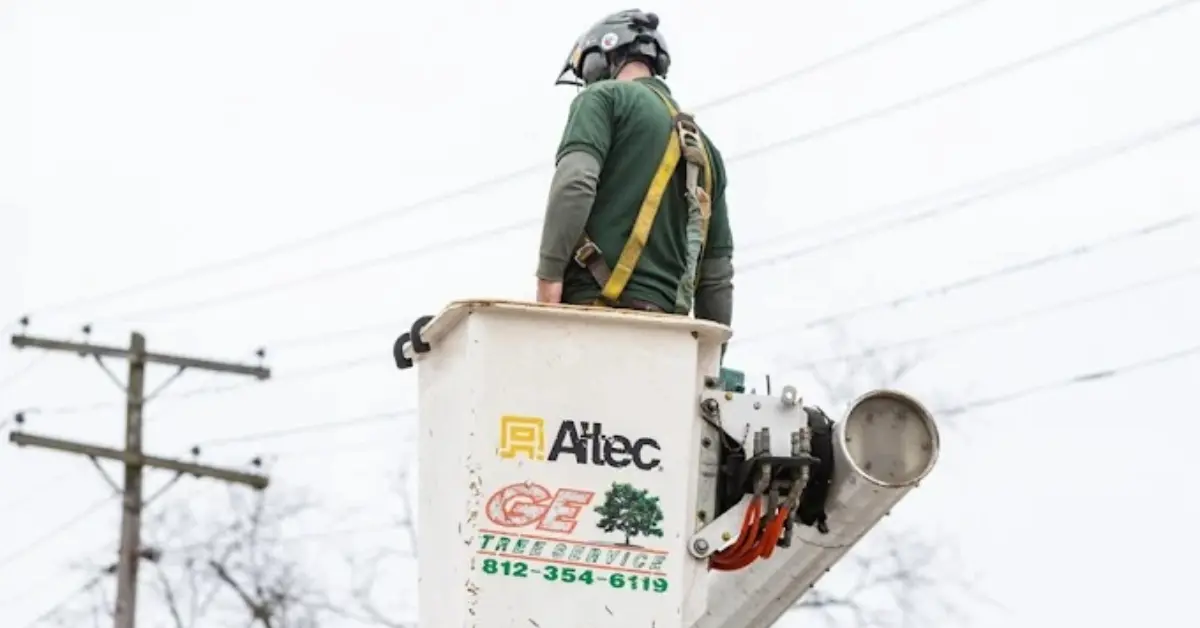
A tree does not have to be dead to be dangerous. A structurally sound-looking White Oak with a hidden decay column at the base. A Silver Maple with co-dominant stems sitting forty feet from a bedroom wall. A Tulip Poplar with a root system compromised by seasonal flooding near the Patoka River corridor that looks completely normal from the street. Tree risk is not always visible. It is always present. GE Tree Service provides professional tree risk assessments across Petersburg, IN and Southwest Indiana using ISA risk assessment methodology and 33 years of Wabash Valley experience.
📞 CALL NOW: (812) 354-6119
What Our Tree Risk Assessment Actually Provides
Tree risk assessment is a structured analytical process, not a visual inspection. It quantifies the probability that a specific tree or tree part will fail and the consequences of that failure, given what is directly in its path.
Every assessment evaluates three components.
Likelihood of Failure: Structural integrity based on species, defect type, decay extent, root system condition, and the mechanical loads the tree regularly experiences across Southwest Indiana weather events.
Likelihood of Impact: Whether a failure would actually strike a target. A tree falling into an open field presents negligible consequences regardless of how structurally compromised it is. The same defect positioned forty feet from an occupied residence changes the calculation entirely.
Consequences of Failure: Severity of potential damage based on what occupies the target zone. Occupied structures and areas of frequent human activity in Daviess County carry maximum consequence ratings.
The intersection of these three components produces a risk rating that determines the appropriate management response.
Who Needs a Formal Tree Risk Assessment in Southwest Indiana
- Pre-storm season evaluation: Identifying high and extreme risk trees before derecho season or the Southwest Indiana ice storm window.
- Post-storm inspection: Trees that survived a storm but sustained root heaving, internal fractures, or partial failure are at elevated risk going forward.
- Pre-sale and real estate transactions: Buyers and sellers across Pike, Gibson, and Knox Counties increasingly require formal written risk documentation before closing. The Insurance Information Institute outlines how documented tree condition affects liability exposure and coverage outcomes for property owners during real estate transactions.
- Insurance documentation: Carriers and adjusters require ISA-standard written assessments to process claims and establish pre-loss condition records. The International Society of Arboriculture defines the credentialing and documentation standards that insurance carriers and courts recognize as authoritative in tree risk proceedings.
- HOA and municipal compliance: Formal risk documentation for trees near shared infrastructure or public right-of-way in the Petersburg and Washington areas.
- Legal and liability proceedings: Property damage disputes involving tree failure in Southwest Indiana courts require credentialed risk assessment documentation. The Wikipedia entry on tree risk assessment provides foundational detail on the ISA quantified risk assessment methodology used as the evidentiary standard in liability proceedings across the United States.
- Construction planning: Pre-construction assessment identifies structural hazards to workers and equipment during clearing phases on Daviess County build sites. The USDA Forest Service urban forestry program documents best practices for tree hazard evaluation in construction zones, including protocols for protecting high-value trees within the disturbance footprint.
Local Risk Factors That Elevate Tree Failure in Southwest Indiana
The Wabash Valley creates a specific combination of stressors that elevate failure risk above national averages for comparable species and defect types.
Derecho frequency across Daviess, Gibson, and Knox Counties is among the highest in the Midwest. Straight-line winds place omnidirectional loading on structural defects that have held for decades under typical conditions but fail when loading direction and magnitude exceed what the union has previously experienced.
Clay-heavy soils throughout the Petersburg and Washington areas become fully saturated within hours of significant rainfall. Root anchorage in saturated clay is dramatically reduced. Trees presenting moderate risk under normal conditions elevate to high risk following extended wet periods.
Ice storm events place lateral and vertical loading on branch unions simultaneously. Included bark between co-dominant stems that survives wind loading frequently fails under combined ice and wind because the ice weight eliminates the mechanical advantage the union relies on to resist separation.
Emerald Ash Borer mortality has left standing dead ash timber throughout Southwest Indiana. Dead ash becomes extremely brittle within 12 to 18 months of mortality. Every standing dead ash tree within striking distance of a structure in Daviess or Gibson County is an extreme risk specimen by definition.
Our Tree Risk Assessment Process in Southwest Indiana
- Step 1 – Target Zone Identification: Every potential impact target within the failure radius is mapped including occupied structures, vehicles, utilities, and areas of frequent human activity
- Step 2 – Ground Level Structural Inspection: Full 360-degree evaluation of root flare, trunk, bark, and lower canopy with decay indicators, structural defects, and pest evidence documented
- Step 3 – Upper Canopy Assessment: Aerial lift deployed where upper canopy branch attachments or co-dominant stem conditions require close inspection beyond ground observation
- Step 4 – Soil and Root Zone Evaluation: Compaction, drainage, root flare exposure, and basal decay assessed in the context of local soil conditions across Daviess, Pike, or Gibson County
- Step 5 – Risk Rating Assignment: Likelihood of failure, likelihood of impact, and consequence of failure combined into an overall rating following ISA Basic Tree Risk Assessment methodology
- Step 6 – Written Report Delivery: Formal documentation of findings, risk ratings, and prioritized management recommendations formatted for insurance, legal, HOA, or personal use
📞 CALL NOW: (812) 354-6119
Understanding Your Risk Rating
Low Risk: Current conditions do not indicate significant failure probability. Routine monitoring on a defined schedule is the appropriate response.
Moderate Risk: Identifiable defects elevate failure probability above baseline. Mitigation through pruning, cabling, or treatment is recommended to reduce risk to an acceptable level.
High Risk: Significant failure probability with meaningful consequence potential. Prompt mitigation or removal is warranted. Deferring action on a high risk tree in Southwest Indiana increases exposure with every storm event.
Extreme Risk: Imminent failure probability combined with high consequence target exposure. Immediate action required. An extreme risk tree near an occupied structure in Daviess County is not a deferred maintenance item. It is an active liability.
What Affects Assessment Cost in the Petersburg Area
- Number of trees: Single specimen assessment differs from a full property survey or pre-construction canopy evaluation
- Aerial lift requirement: Upper canopy inspection on tall White Oak or Tulip Poplar requires equipment deployment reflected in the estimate
- Report format: Insurance documentation, legal proceedings, and HOA submissions require formal written reports beyond a standard summary
- Site complexity: Multiple mature trees near structures throughout Washington and Petersburg require comprehensive target zone mapping
Free consultation on every risk assessment inquiry. Clear pricing before any evaluation begins.
📞 CALL NOW: (812) 354-6119
Why Daviess County Property Owners Trust GE Tree Service
- 33 years assessing structural risk across Pike, Daviess, Dubois, Gibson, and Knox Counties
- ISA Basic Tree Risk Assessment methodology on every formal evaluation
- ISA Member and TCIA Member with current credentialing
- Aerial lift access for upper canopy inspection on tall specimens
- Written reports accepted by insurance carriers, HOAs, and legal proceedings across Southwest Indiana
- Indiana Commercial Pesticide License 255155 and Applicator License 275795
- Honest risk ratings based on findings not service revenue
- BBB Accredited A+ Rated, family owned and locally operated since 1991
Service Area
GE Tree Service provides professional tree risk assessments throughout Southwest Indiana from our base at 1202 Spruce St, Petersburg, IN 47567.
- Pike County: Petersburg, Otwell, Winslow, Velpen
- Daviess County: Washington, Montgomery, Cannelburg, Plainville, Spurgeon, Stendal, Monroe City
- Dubois County: Jasper, Huntingburg, Ireland
- Gibson County: Princeton, Fort Branch, Oakland City
- Knox County: Vincennes, Monroe City
Frequently Asked Questions About Tree Risk Assessment in Petersburg, IN
How is tree risk assessment different from a tree health assessment?
A health assessment evaluates biological condition and canopy health. A risk assessment quantifies the probability and consequence of structural failure using ISA methodology and produces a formal written risk rating for insurance, legal, or HOA purposes.
Does a high risk rating always mean removal in Southwest Indiana?
No. High risk trees are candidates for mitigation through structural pruning or cabling depending on the defect type. Extreme risk trees near occupied structures typically require removal because mitigation cannot reduce risk to an acceptable level given the consequence exposure.
Can a risk assessment report support insurance claims in Daviess County?
Yes. Our written reports follow ISA methodology and are accepted by insurance carriers across Southwest Indiana for claims processing, pre-loss documentation, and liability dispute resolution.
Do you assess trees for pre-sale property transactions near Petersburg?
Yes. Pre-purchase assessments identify structural hazards and deferred maintenance obligations before a transaction closes. This is one of the most cost-effective assessments a buyer in Daviess, Gibson, or Knox County can commission before taking ownership of a property with mature trees.
How long does a formal assessment take in the Washington and Petersburg areas?
Most single-tree assessments take one to two hours, including documentation. Multi-tree property surveys require proportionally more time based on specimen count and target zone complexity.
What is the difference between low and moderate risk management?
Low-risk trees require scheduled monitoring to track defect progression. Moderate risk trees require active mitigation within a defined timeframe to prevent progression to high risk through pruning, cabling, or increased inspection frequency.
Know Your Risk Before the Storm Decides for You
A tree risk assessment does not prevent storms. It prevents the preventable consequences of storms. GE Tree Service brings 33 years of Southwest Indiana structural assessment experience, ISA methodology, and honest risk documentation to every evaluation across Daviess County and surrounding communities.
Schedule a professional tree risk assessment today.

