

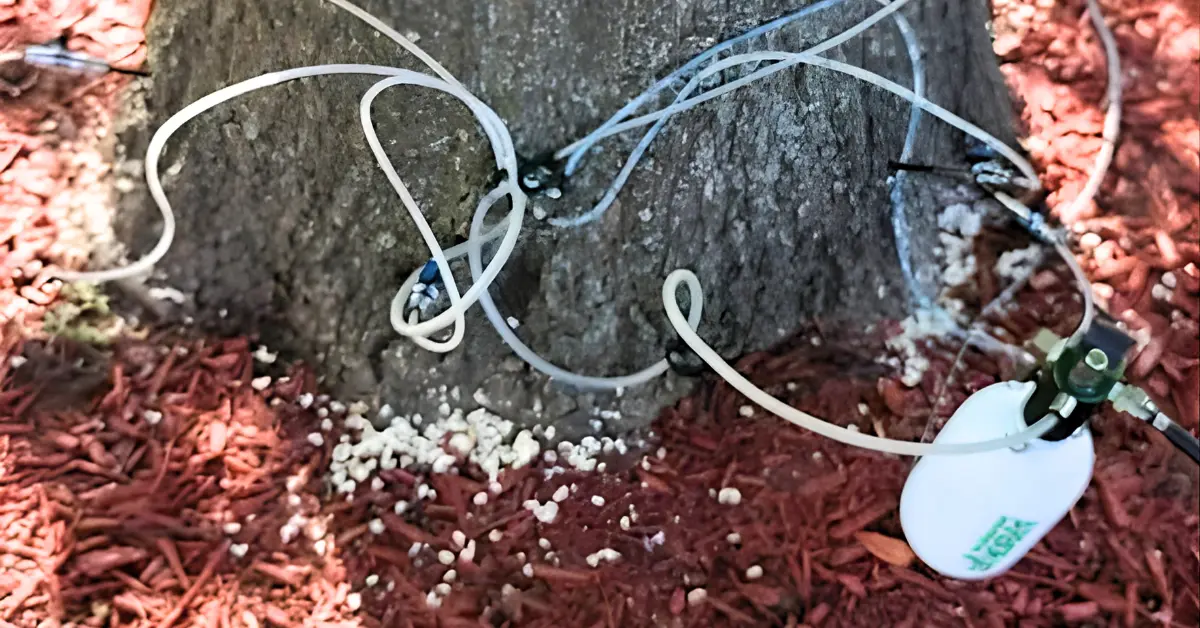
A tree under attack from inside does not show visible symptoms until the damage is already advanced. Emerald Ash Borer larvae tunneling beneath the bark. Oak Wilt blocks water movement through the vascular system. Verticillium Wilt is moving upward through the root system in Daviess County clay soil. By the time most homeowners notice something is wrong, the treatment window is already narrowing.
GE Tree Service provides professional systemic tree injections in Petersburg, IN and across Southwest Indiana. Every treatment is performed by licensed applicators under Indiana Commercial Pesticide License 255155 and Applicator License 275795.
📞 CALL NOW: (812) 354-6119
What Systemic Injection Treatment Does
Systemic injection delivers pesticide, fungicide, or nutrient solution directly into the tree’s vascular system. The treatment moves through the tree’s own water and nutrient transport network, reaching the target pest or pathogen at the source rather than relying on surface absorption or soil uptake.
This method is more targeted, more effective, and causes significantly less environmental exposure than broadcast spraying. No product drift. No runoff into the surrounding soil or groundwater. No risk to neighboring plants or pollinators. The treatment stays inside the tree where it needs to work.
GE Tree Service uses professional-grade injection equipment on every application. Every treatment is matched to a confirmed diagnosis, not applied speculatively.
Conditions We Treat With Systemic Injections Across Southwest Indiana
- Emerald Ash Borer: Systemic emamectin benzoate or imidacloprid injection is the only viable treatment for active or at-risk ash trees in Daviess, Gibson, and Knox Counties. Treatment must begin before canopy decline exceeds 50 percent. The USDA Forest Service documents approved treatment compounds, application timing, and canopy threshold guidelines for property owners managing ash timber across Southwest Indiana.
- Oak Wilt: Propiconazole fungicide injection slows vascular blockage and can halt disease progression in White and Red Oak when combined with root graft disruption between neighboring trees. The Wikipedia entry on Oak Wilt details how Bretziella fagacearum spreads through connected root systems and why chemical barrier installation is a standard component of treatment in high-density oak stands.
- Verticillium Wilt: Soil-borne fungal pathogen, particularly aggressive in the clay-heavy soils throughout the Petersburg and Washington areas. Trunk injection combined with soil amendment addresses both the active infection and the root zone conditions that allow it to persist.
- Scale insects and borers: Systemic insecticide injection reaches wood-boring beetles and scale populations that surface sprays cannot penetrate through protective bark layers.
- Iron chlorosis: Nutrient injection corrects iron deficiency caused by high soil pH in Daviess County clay soils, where iron is present but chemically unavailable to the root system. Purdue Extension provides Indiana-specific guidance on soil pH management and nutrient availability in the clay-heavy soils common throughout the Wabash Valley.
- Anthracnose and fungal canker: Fungicide injection provides internal protection for high-value Sycamore, White Oak, and Black Walnut specimens showing repeated seasonal infection across Southwest Indiana. The USDA PLANTS Database entry for Sycamore documents the species’ regional distribution and known disease pressures, helping property owners understand why high-value specimens in bottomland areas require proactive treatment programs.
Why Injection Is the Right Choice for Southwest Indiana Trees
The soil and climate conditions across the Wabash Valley make systemic trunk injection one of the most effective treatment methods for protecting trees.
Clay-heavy soils across Daviess and Pike Counties slow the movement of soil-applied treatments. Trunk injection bypasses compacted soil and delivers treatment directly into the tree’s vascular system.
Emerald Ash Borer pressure across Gibson, Knox, and Daviess Counties remains severe. Preventative injections are the most reliable way to protect healthy ash trees before canopy decline begins.
Oak Wilt spreads underground through root grafts between nearby White Oaks. Fungicide injection combined with root graft disruption can stop the disease before it spreads to neighboring trees.
Southwest Indiana’s humid summers create constant fungal pressure on Maples, Sycamores, and Oaks. Preventative injections during the correct treatment window help interrupt repeated infections before long-term damage occurs.
Our Systemic Injection Process in Southwest Indiana
- Step 1 – On-Site Diagnosis: Full tree health assessment to confirm pest or disease identification, evaluate canopy condition, and determine treatment viability before any product is selected
- Step 2 – Treatment Plan Development: Species-specific injection protocol developed based on confirmed diagnosis. Product, dosage, application timing, and follow-up schedule established in writing.
- Step 3 – Site Preparation: Injection port locations identified at the root flare. Surrounding area assessed for utility proximity and soil conditions.
- Step 4 – Professional Injection Application: Licensed applicators deliver treatment directly into the vascular system using professional-grade equipment. All applications follow Indiana pesticide label requirements.
- Step 5 – Documentation and Follow-Up: Treatment record provided, including product, dosage, and application date. Follow-up assessment scheduled to evaluate treatment response and determine whether additional cycles are needed.
📞 CALL NOW: (812) 354-6119
What Affects Systemic Injection Cost in the Petersburg Area
Injection cost is driven by tree diameter, product type, number of trees, and treatment frequency. We provide transparent on-site estimates before any application begins.
- Tree diameter at breast height: Injection dosage scales directly with trunk diameter. Larger trees require more product and more injection ports.
- Product type: Emamectin benzoate for Emerald Ash Borer carries a higher per-unit cost than imidacloprid, but provides longer protection per application cycle
- Number of trees: Multi-tree treatment programs on a single property are significantly more cost-efficient than individual tree visits
- Treatment frequency: Preventative programs on healthy trees cost less per cycle than curative treatment on trees in active decline, requiring higher dosage and repeat applications
- Follow-up requirements: Some diseases, including Oak Wilt, require multiple treatment cycles within a single growing season
Free on-site diagnosis and estimate before any treatment begins. We do not recommend or apply products without a confirmed diagnosis.
📞 CALL NOW: (812) 354-6119
Why Southwest Indiana Property Owners Trust GE Tree Service for Systemic Injections
- Indiana Commercial Pesticide License 255155 and Applicator License 275795
- 33 years of diagnosing and treating tree pest and disease problems across Daviess, Dubois, Gibson, Knox, and Pike Counties
- ISA Member and TCIA Member following current arboricultural treatment protocols
- Professional-grade injection equipment for precise vascular delivery
- Accurate on-site diagnosis before every product recommendation
- Full arborist evaluation capability to determine whether treatment or removal is the correct response
- BBB Accredited A+ Rated, family-owned and locally operated since 1991
Service Area
GE Tree Service provides professional systemic tree injections throughout Southwest Indiana from our base at 1202 Spruce St, Petersburg, IN 47567.
- Pike County: Petersburg, Otwell, Winslow, Velpen
- Daviess County: Washington, Montgomery, Cannelburg, Plainville, Spurgeon, Stendal, Monroe City
- Dubois County: Jasper, Huntingburg, Ireland
- Gibson County: Princeton, Fort Branch, Oakland City
- Knox County: Vincennes, Monroe City
Frequently Asked Questions About Systemic Injections in Petersburg, IN
Can systemic injection save an ash tree with Emerald Ash Borer in Southwest Indiana?
Yes, if the tree retains at least 50 percent of its canopy when treatment begins. Emamectin benzoate trunk injection provides two to three years of protection per application. Trees past the 50 percent canopy decline threshold are no longer viable treatment candidates.
How is trunk injection different from spraying or soil drenching?
Injection delivers treatment directly into the vascular system, bypassing soil conditions and surface barriers entirely. In the clay-heavy soils throughout Daviess and Pike Counties, soil drenches move slowly and inconsistently. Injection guarantees the treatment reaches the target site at the required concentration.
Is systemic injection safe for the surrounding plants and soil?
Yes. Treatment is contained within the tree’s vascular tissue and does not disperse into the surrounding soil or groundwater. There is no product drift and no risk to neighboring plants, pollinators, or garden areas adjacent to the treated tree.
How often does a healthy ash tree need a preventative injection in Southwest Indiana?
Most preventative Emerald Ash Borer treatments provide two to three years of protection per injection cycle. We establish a treatment calendar based on tree size and the infestation pressure in your specific location across Daviess, Gibson, or Knox County.
Do you treat Oak Wilt with systemic injection near Washington and Petersburg?
Yes. Propiconazole fungicide injection is the primary treatment for Oak Wilt in White and Red Oak throughout Southwest Indiana. We assess root graft connections between neighboring trees before treatment and recommend disruption measures where spread risk exists.
How do I know if my tree is still a viable treatment candidate?
Call us for an on-site arborist evaluation. Canopy condition, species, pest or disease type, and the extent of current decline all determine whether treatment is viable or whether removal is the safer and more cost-effective option for your property.
Act Before the Treatment Window Closes
Every growing season without treatment for an at-risk tree in Southwest Indiana reduces your options and increases the eventual cost of recovery.
GE Tree Service brings 33 years of Wabash Valley experience, licensed applicators, and accurate diagnosis to every systemic injection service across Daviess County and surrounding communities.
Call Now for Systemic Tree Treatment 📞 (812) 354-6119

