

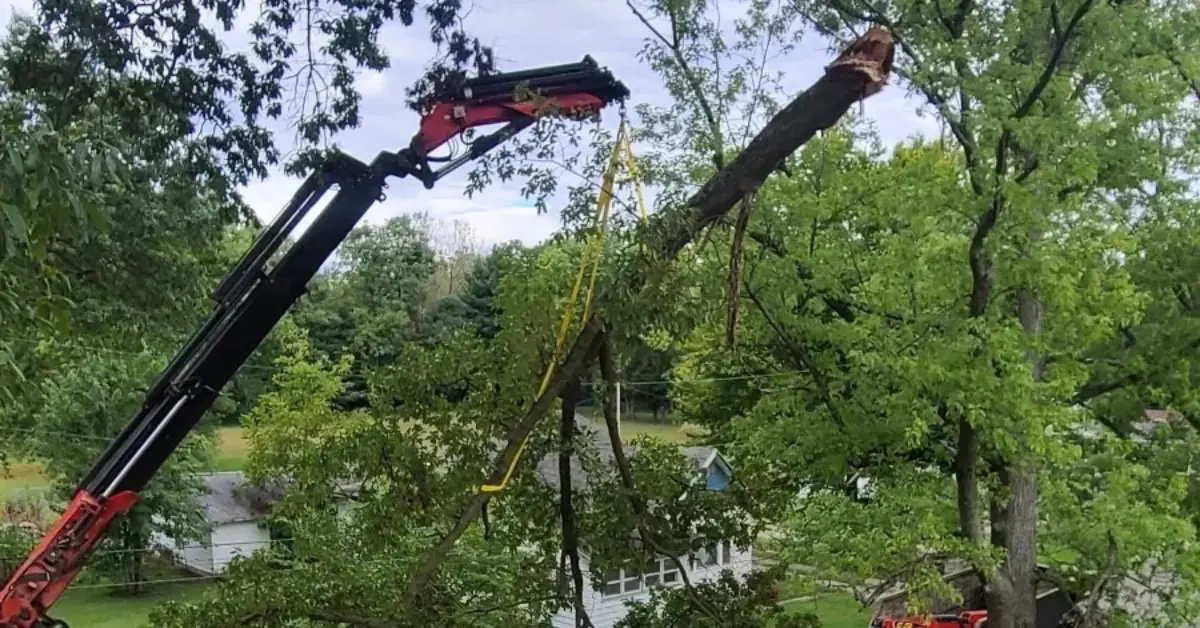
A co-dominant stem does not announce when it will split. A heavy lateral limb on a mature White Oak does not send a warning before it fails under ice load. Structural defects in trees across Southwest Indiana are often invisible from the ground until the next derecho, ice storm, or saturated clay soil event tests them. Cabling and bracing is the structural intervention that reduces failure risk and extends the safe life of trees that are worth saving. GE Tree Service provides professional tree cabling and bracing across Petersburg, IN and Southwest Indiana, backed by 33 years of arboricultural experience and ISA-aligned installation standards.
📞 CALL NOW: (812) 354-6119
When Cabling and Bracing Is the Right Answer
Not every structural defect requires removal. These are the conditions where cabling and bracing is the appropriate interventions for trees across Daviess, Pike, and Gibson Counties.
- Co-dominant stems with included bark: Two stems of equal diameter competing for dominance with bark compressed between them. This is the single most common structural failure point in mature hardwoods across Southwest Indiana.
- Heavy lateral limbs on mature hardwoods: White Oak and Sugar Maple develop large horizontal limbs that accumulate significant weight over decades. Cabling reduces the leverage load at the branch union before it fails.
- V-shaped branch unions: Narrow-angle unions lack the structural wood needed to support the weight of mature growth, particularly under ice load common in Southwest Indiana winters
- Split or partially failed unions that have not fully separated: A union that has begun to crack but has not fully failed can often be stabilized before complete separation occurs
- High-value specimen trees near structures: A century-old Oak or Sugar Maple with sentimental or financial value that would be lost to removal but presents an elevated structural risk without intervention
- Trees with previous storm damage: Partial failures during derecho or ice events that leave the remaining structure compromised and at elevated risk during the next weather event
- Multi-stem ornamental trees: Redbud, Dogwood, and ornamental specimens with multiple stems from a single base that develop increasing spread and leverage as the tree matures
Did You Know? Cabling and Bracing Facts for Southwest Indiana Homeowners
- Co-dominant stems with included bark are statistically the most common structural failure type in mature hardwoods during derecho events across Daviess, Gibson, and Knox Counties
- A properly installed dynamic cable system reduces the load on a weak union by distributing weight and limiting the range of motion that causes failure under wind and ice stress
- Cabling does not eliminate risk entirely. It reduces risk to an acceptable level for trees where the value of retention outweighs the managed residual risk after installation.
- Ice storms throughout Southwest Indiana place lateral loading on branch unions that exceeds the failure threshold of compromised attachments. Bracing rods through the union provide direct structural reinforcement against this specific load type.
- Trees with installed cable systems require periodic inspection every two to three years to assess cable condition, hardware integrity, and whether the structural defect has progressed beyond the point where the system remains effective
- Removing a co-dominant stem through proper structural pruning during a tree’s early years eliminates the need for cabling later. Developmental pruning on young trees across Washington and Petersburg residential properties is the most cost-effective long-term structural investment.
Cabling Versus Bracing: What Each System Does
These are two different interventions that address different types of structural failure. We use both, sometimes in combination on the same tree.
- Dynamic Cabling: High-strength synthetic or steel cable installed in the upper canopy between co-dominant stems or heavy lateral limbs. The cable limits the range of motion that causes unions to fail under wind load while allowing the natural movement that promotes wood strength development. Used where the primary risk is wind-induced separation. The International Society of Arboriculture outlines industry standards for cabling systems, including hardware specifications and inspection intervals recommended for high-value trees in residential and commercial settings.
- Static Bracing Rods: Threaded steel rods installed through a compromised union or split stem to provide direct mechanical reinforcement. Used where a union has already begun to fail, where ice load is the primary concern, or where the geometry of the defect makes cable installation insufficient as a standalone solution. The Wikipedia entry on tree bracing details the mechanical principles behind rod installation and the conditions under which static systems outperform dynamic alternatives. Bracing rods are often used in combination with cabling for maximum structural support.
- Combined Systems: Many mature hardwoods with multiple structural defects across Daviess and Knox Counties require both cable and rod installation to address different failure modes in the same tree. We assess each defect independently and design the system to address the full structural picture. Purdue Extension provides Indiana-specific guidance on structural defect assessment in mature hardwoods, and the USDA Forest Service urban forestry program documents how combined support systems extend the functional lifespan of high-value canopy trees in residential landscapes across the Midwest.
Our Cabling and Bracing Process in Southwest Indiana
Every installation starts with a thorough structural assessment. We do not install hardware without understanding the full failure picture.
- Step 1 – Structural Assessment: Full evaluation of union geometry, included bark extent, wood decay, canopy weight distribution, and proximity to structures. We identify every defect and determine which are addressable through hardware installation.
- Step 2 – System Design: Cable and rod placement, hardware specifications, and installation approach determined based on the specific defect type, tree species, and structural load requirements
- Step 3 – Written Recommendation: Clear explanation of what the system will and will not do. Honest assessment of residual risk after installation so you can make an informed retention decision.
- Step 4 – Professional Installation: Aerial lift used to access upper canopy cable attachment points without climbing spurs that damage bark. All hardware installed to ANSI A300 standards.
- Step 5 – Inspection Schedule: We establish a follow-up assessment timeline appropriate to the defect severity and system type. Most installed systems require inspection every two to three years.
📞 CALL NOW: (812) 354-6119
What Affects Cabling and Bracing Cost in the Petersburg Area
Installation cost depends on tree size, defect type, number of attachment points, equipment access, and hardware specifications.
- Tree height and canopy access: Upper canopy cable installations on tall White Oak or Sugar Maple specimens require aerial lift positioning that adds to the overall scope
- Number of defects: A single co-dominant stem requires one cable installation. A mature Oak with multiple heavy laterals and a split union requires a more complex combined system.
- Hardware specifications: Dynamic synthetic cable systems differ in cost from static steel rod installations. Combined systems carry higher material and labor costs than single-component installations.
- Site access: Tight yards, fenced properties, or soft ground near creek corridors in Daviess and Pike Counties affect equipment positioning and labor time
- Follow-up inspection: Periodic system inspections are a separate scope item from the initial installation
Free on-site structural assessment and estimate before any installation begins.
📞 CALL NOW: (812) 354-6119
Why Daviess County Homeowners Choose GE Tree Service for Tree Cabling
- 33 years installing cabling and bracing systems across Pike, Daviess, Dubois, Gibson, and Knox Counties
- ISA Member and TCIA Member following ANSI A300 installation standards
- Aerial lift access for upper canopy hardware installation without climbing spurs
- Structural assessment capability to determine whether cabling is viable or removal is the appropriate response
- Honest residual risk communication before every installation
- 112-ft crane and full equipment fleet for complex multi-point installations on large specimens
- BBB Accredited A+ Rated, fully insured, family owned and locally operated since 1991
Service Area
GE Tree Service provides professional cabling and bracing throughout Southwest Indiana from our base at 1202 Spruce St, Petersburg, IN 47567.
- Pike County: Petersburg, Otwell, Winslow, Velpen
- Daviess County: Washington, Montgomery, Cannelburg, Plainville, Spurgeon, Stendal, Monroe City
- Dubois County: Jasper, Huntingburg, Ireland
- Gibson County: Princeton, Fort Branch, Oakland City
- Knox County: Vincennes, Monroe City
Frequently Asked Questions About Cabling and Bracing in Petersburg, IN
Does cabling eliminate the risk of tree failure in Southwest Indiana?
No. Cabling reduces risk to a manageable level for trees where retention value outweighs residual risk after installation. We communicate this honestly before every job. A properly designed and installed system significantly reduces the probability of failure but does not provide an absolute guarantee against it.
How long does a cabling system last on a Southwest Indiana hardwood?
Most hardware has a functional lifespan of 10 or more years depending on material, installation quality, and how the defect progresses over time. Periodic inspection every two to three years determines whether the system remains effective or requires adjustment.
Can you cable a tree that has already partially split near Washington or Petersburg?
Often yes. A union that has begun to crack but has not fully separated can frequently be stabilized with a combined cable and bracing rod system. Full separation or advanced decay at the union typically requires removal assessment rather than hardware installation.
Is cabling recommended before or after storm season in Indiana?
Before. Installing a cable system before the derecho season or ahead of Southwest Indiana’s ice storm window is the correct approach. Installing hardware after a failure has already occurred addresses the symptom rather than the structural condition that caused it.
How do I know if my tree needs cabling or removal?
An on-site structural assessment determines whether the defect is addressable through hardware installation or whether the extent of decay, failure progression, or proximity to structures makes removal the only safe option. We provide honest recommendations based on what we find.
Protect What Is Worth Saving
Not every structurally compromised tree needs to come down. Some of the most valuable trees on properties across Daviess County simply need the right intervention at the right time. GE Tree Service brings 33 years of Southwest Indiana experience, ANSI A300 installation standards, and honest structural assessment to every cabling and bracing job across the region.
Call GE Tree Service today to schedule a cabling and bracing evaluation.

